
Speed Reading For Education

7 Speed Reading EDU is the world's most advanced accelerated reading system for schools. Based on proven principles of faster reading, 7 Speed Reading EDU contains all the features of 7 Speed Reading plus:

The next step is to see 7 Speed Reading for yourself. Simply fill out the form and we'll send you a free no obligation trial of the full version of 7 Speed Reading EDU.

speedreadingtechniques.org

On the pro side it has easy-to-use interface, video tutorials, multiple user accounts, well-structured course system for beginners & advanced students plus the ability to exercise with any digital text.

Elbert Zeigler

"I found 7 Speed reading. Doing eye exercises, warm-ups before reading, and how to look at words in groups instead of one at a time improved my reading and comprehension. I recommend 7 Speed Reading for you."

courselounge.com

7 Speed Reading is a decent speed reading software with an innovative approach. The customizable features are quite appealing since it allows you organize your speed reading training effectively.

Daniel Walters

"I have always struggled with reading slowly. Once I started using 7 Speed Reading, I did notice an improvement from approx. 200 wpm to 300 wpm."

winningspirit.com

If you want to learn how to speed read so that you can read everything faster, your best option is to get the self-paced speed reading course called 7 Speed Reading. It is designed to be the world’s most powerful speed-reading training program.

bestadvisor.com

From learning how to read and comprehend faster to how to keep your eyes healthy, everything is covered in this course for almost any age, and a team of professionals will help you master it.

Stephen L. (Reviewer)

I liked the accessibility of it. It helps, because users are able to easily maneuver throughout the software to varying levels and practice their reading at varying speeds.

Devad Goud

After having used this software, I learned techniques and skills such as eliminating my subvocalization, which not only greatly enhanced my speed reading, but also allowed me to get more engagement in what I read.

Reinard Mortlock

The biggest problem I had was sub-vocalization, 7 Speed Reading helped a lot with techniques to improve this and substantially improve my reading speed. The application is easy to use with loads of books to read to improve your reading skills.

Adel Serag

When I seriously exercise using the app, in no time, my reading speed goes from less than 400 to 600 and my target is 900 plus.

Nik Roglich

The pace trainer is great for getting my eyes focused and sharp. Also the word search exercise is very important, gets me searching for specific text.

Jose Godinez

I have improved my speed reading and comprehension since I started using 7 Speed Reading, I enjoy using it and I will continue to use it in the future.

Millions of Free Online Articles Now Available at JSTOR


Since 1995, JSTOR (a “journal storage” site) has helped students, researchers, and teachers keep up with the latest in academic journals and articles by offering free or low-cost subscriptions to access this information from thousands of sources. However, most students lose their free access to the system after they graduate, and until now the site resources have not been fully accessible to the public. With JSTOR’s new “Register & Read” program the valuable information from hundreds years of research and writing is now available to anyone who creates a free account through the site.

The JSTOR archives are of crucial importance to anyone interested in learning more about history, because the site contains articles and publications dating back centuries. Reading what people wrote about their daily lives, thoughts, scientific advances of the day, and current culture in the 18th or 19th century gives you an incredible perspective about those eras, and a better understanding of how things have changed since then – or how little things have changed.

New ways of thinking, new discoveries, and new information are constantly being written about by talented students and researchers, but these papers and articles are hard to find outside of the library of the specific school where those students and researchers are located. JSTOR was created to make a “digital library” where these important documents could be stored and accessed. It’s a significant contribution to the global knowledge database.

One of the best ways to encourage people to read more is to provide more reading materials, and that’s what the Register & Read program does. What’s more, if you take advantage of this opportunity to access the articles on a wide range of topics, you’ll not only increase your knowledge of those subjects, but you’ll also improve your vocabulary. Anyone working on improving speed reading skills knows the importance of a good vocabulary in developing good speed reading habits.

The JSTOR Register & Read program is free, and you can sign up here. What are you waiting for? A world of reading is just a few clicks away.
England’s Premier League Makes Reading Fun


“Mum, Dad, do I have to?” If that sounds familiar, you’re not alone. One of the most frustrating things in parenting is trying to get kids enthusiastic about something they don’t feel like doing, whether that’s eating vegetables, picking up their toys, helping around the house, or doing homework. If reading is one of the things that your child doesn’t enjoy, that can cause problems for them in their classrooms, which means there will be even more fighting and complaining when it comes time to do homework and study throughout the school year. Since there’s a definite link between reading skills and school success, helping children learn to enjoy reading is important.

In the UK, the National Literacy Trust has taken this to heart, and has partnered with the Premier League to promote good reading habits. Sports events and athletics stars are great ways to catch a kid’s interest, and once they get interested they’ll find it easier to keep working on something they once thought was “no fun.” The football players (soccer, for our US-based readers) have helped create a series of video challenges that prompt children to read more and improve their reading and comprehension skills. Not only that, but kids can win prizes by correctly answering the quiz questions associated with the short films. Footballers share their favorite books as well, and that encourages kids to go out and read those books, so they can be “just like” their heroes.

Parents are encouraged to get involved, as well as schools, though students don’t need to be directly associated with a school in order to participate. According to the National Literacy Trust, the reading-challenged students that took part in the Premier League Reading Stars program showed a fifty percent increase in reading skills, with those students significantly improving their reading ability in less than four months.

If you’re in the UK, you can contact the National Literacy Trust for more information on how to get your child involved, either alone or as part of a school group. But no matter where you are, you can use the information on the site to come up with new ways to encourage your child to read more – just pick a sports star or actor they idolize, and look for news clips or information about what that person likes to read or learn about. Enthusiasm is key when it comes to reading, and if you can show a child that you and the other adults in their life have fun reading, they’ll think it’s fun, too.

Jessa Crispin Features New Writing, Book Reviews, And Literary Opinions At BookSlut.com


For over a decade the focus at BookSlut.com has been on brilliant writing – fiction, nonfiction, poetry, essays, works of new authors you’ve never heard of and forgotten pieces from well-known authors you loved in the past. Editor Jessa Crispin, a professional writer herself, has created a site that appeals to a broad range of readers due to its engaging and eclectic selections. We asked her a few questions about the history of the website and the culture of reading.

7S: What made you decide to start the BookSlut site in 2002?

JC: Boredom. I had a lot of time on my hands at my day job and needed to do something that vaguely looked like work to fill the days. It wasn’t until later, when I was surprised to find out other people were actually reading it, too, that I realized I was going to have to take it seriously.

7S: You’ve featured interviews with well-known authors like Kage Baker, Steven Brust, and Neil Gaiman, but also conversations with writers like André Aciman and Santiago Roncagliolo, who aren’t exactly household names in the United States. How do you decide who to interview next?

JC: We leave it up to our contributors to pitch names. But we read everything from the incredibly obscure to the more well known fantasy writers, so who we profile tends to reflect who we are reading.

7S: In the current issue there are twice as many reviews of nonfiction works as of fiction. Is this because there is more nonfiction being written – at least more that is worthy of attention – or for some other reason, if any?

JC: Honestly, it’s because I find contemporary fiction to be so very underwhelming. Like I said, what we profile on the site tends to reflect our reading habits, and for the last couple years, contemporary American fiction has been uninspiring. And yet nonfiction — and by which I do not mean exclusively memoir, because we don’t read much memoir, either — has been quite good in the last years. So we regularly review more nonfiction than fiction.

7S: What’s your perspective on the relationship between reading and writing? Is a good writer always someone who is also a voracious reader?

JC: Every once and a while I’ll meet an author who claims not to read very much, and I have to say, I pretty much immediately lose all interest in reading their books. If you’re not rapturously in love with the literary world you are trying to become a member of, then why bother? Writing should never only be about personal expression. It’s about art, it’s about people in general, it’s about beauty and truth and philosophy and all that stupid stuff. One has to embrace it whole heartedly, or else your writing simply becomes an exercise in narcissistic excess.

7S: What’s the last book you read, and what’s on your upcoming “must read” list?

JC: The last book I read was a nonfiction book called “After Lives,” and it was a guide to various culture’s beliefs and myths about the afterlife. Today I started “Snow” by Orhan Pamuk on the train. It sounds trite to call a work by someone who has already won the Nobel “amazing,” but there you go, it is.

How to Succeed in Speed Reading


You’ve probably been able to read ever since you were a child, and you don’t even think about how to read now, because you’ve been doing it so long. You’ve learned the rules of reading so well that it’s an automatic process, something that seems easy because you’re so practiced at it. Speed reading works the same way. If you’re worried that you won’t learn how to speed read, or that you’ll be so focused on remembering the tips and recommendations for better reading speed that you won’t pay attention to the text, don’t worry. Just as when you first learned to read, it just takes a little time and practice, and you’ll soon forget that there ever was a time when you didn’t know how to speed read.

Stay focused. When you concentrate, you focus your mind on what you’re doing, and that means that you’ll improve more quickly in whatever it is you’re doing. Help your focus by getting rid of distracting sounds and outside interruptions when you read.

Move forward. Re-reading text when you don’t have to will simply slow you down. If you find that you’re automatically going back to read the previous paragraph, use a piece of paper to cover text as you read it, so that you’re forced to move on to the next section.

Think big. Your eyes and brain can take in more than you might think. Try reading groups of words, rather than taking each word in the sentence separately. Learn to let your eyes move freely and quickly over each line to help you absorb phrases instead of individual words.

Let go. Get rid of any anxiety you have about what you’re reading and whether you’re doing it right. Even if you’re under some time pressure, when you relax you’ll be able to keep the flow of information running smoothly from your eyes into your brain. You might be surprised at just how quickly you can read, when you’re not worried about how quickly you’re reading!

Robert Wilson And TheAmericanScholar.org Showcase The Best American Writing


Award-winning magazine The American Scholar has been publishing interesting essays on a wide range of topics since 1932. Now with an accessible web site that helps even more people discover information on subjects they may never have even thought of, The American Scholar provides essays, book reviews, fiction and non-fiction writing that encourage people to think, to explore, and to read. 7 Speed Reading talked to editor Robert Wilson recently about the magazine and the articles he chooses for publication.

7SR: When The American Scholar was first published, there was no such thing as a “10-second sound byte” or a 140-character limit on communication. What keeps people coming back to longer, in-depth articles and discussions in today’s amped-up, abbreviated world?

RW: My experience as a journalist goes back long before Twitter and indeed before the web, and for as long as I can remember this question of the reader’s attention span has been argued. The answer is that there will always be some readers who don’t want to read longer pieces and some who do. Look at the best-seller lists: many people clearly read long books in all formats. My sense is that the jumble of the web and of other modern media make certain readers hunger for pieces that can make a sustained argument, or that try to make sense of things. Not all readers, clearly, but enough.

7SR: Recent issues of the magazine have covered topics ranging from apartment hunting in modern Manhattan to a 19th-century British explorer to how laughter might help us understand the brain – that’s quite different from the specialized magazines that focus on one thing (cats, cooking, cars). How do you choose the articles for each issue?

RW: I’ve often told the editors with whom I’ve worked that my goal is to never be useful to the reader. If you want to know how to groom your cat, please go elsewhere. We seek merely to engage, to entertain, and perhaps occasionally to enlighten our readers. What a general-interest magazine such as ours can do, I hope, is fight RSS thinking. That is, we hope to make our readers interested in or think about subjects that they didn’t know they wanted to read about. We simply choose articles that interest us, that feel fresh, and that are well argued and well written.

7SR: You became the magazine’s editor in 2004, and two new features have been added since then: fiction writing in each issue, and a web site to go along with the printed publication. Were these your ideas?

RW: We started publishing fiction when a friend suggested that we ought to do it because The Atlantic had stopped publishing fiction in its regular issues. (They’ve since started again.) By the time I became editor, it was embarrassing for a publication not to have a web site. So yes, I got ours rolling.

7SR: Book reviews are a regular feature of the magazine, and they’re a good way to get ideas about what books to read next. Do you generally read the books that are reviewed in your magazine?

RW: I often read in a number of books as we decide what to review or as we look for possible excerpts. And someone on the staff—usually our book-review editor, Bruce Falconer—has read at least part of each book we assign. But no, I don’t generally read all the books we review.

7SR: If readers find they’re particularly interested in one topic, can they request more information or more articles in future issues?

RW: We’re eager to hear from readers, but once we cover a particular subject we are not likely to go back to it again anytime soon. Search engines have pretty much eliminated the need for readers to come to us for more information, but when they do we are happy to accommodate them.

A Simple Trick To Improve Your Child’s Reading And Vocabulary Skills


The results of an amazing study are only now getting the attention they deserve, and the technological tools researchers need to prove once and for all that there’s a simple trick to raising a child’s vocabulary skills, reading ability, and even intelligence: conversation. At first glance, it might seem to be too simple – after all, everyone talks to their children, don’t they? But as the study shows, it’s important to talk to children frequently, and it’s important that those talks aren’t just a series of “do this!” or “stop that!” orders. Instead, children get the most out of conversations where they’re exposed to new words and prompted to use those words in their answers.

One of the most striking statistics from the study states that “by age 3, a [child on welfare] would have heard 30 million fewer words in his home environment than a child from a professional family.” 30 million words – that’s a lot of vocabulary opportunity that’s missing for that child. And since vocabulary skill is directly connected to reading ability, that means a child in this situation will probably also have a harder time reading, and they’ll be reading at a slower speed. Once bad reading habits get started, they’re hard (though not impossible) to fix.

One significant finding from the study showed that once parents and caregivers started talking more with the children, it didn’t matter what the family situation was; children at all income levels showed immediate improvement in their vocabulary and reading. The city of Providence, Rhode Island is using this information to start a city-wide initiative to help families understand the importance of conversations at home, and to practice good conversational skills. As the study points out, substituting television for one-on-one conversations doesn’t help, and in fact makes things worse. If you live in Providence, you might be able to sign up through the Nurse-Family Partnership. This organization is a good resource for any family, and there are offices in most areas of the United States.

Have you hugged your kid today – and talked to them, too?

Read more about the study here.

Related research: C. Snow and Z. Weizman, “Lexical input as related to children’s vocabulary acquisition” Developmental Psychology (2001)

Cross-posted at The Vocabulary Builder’s Blog.

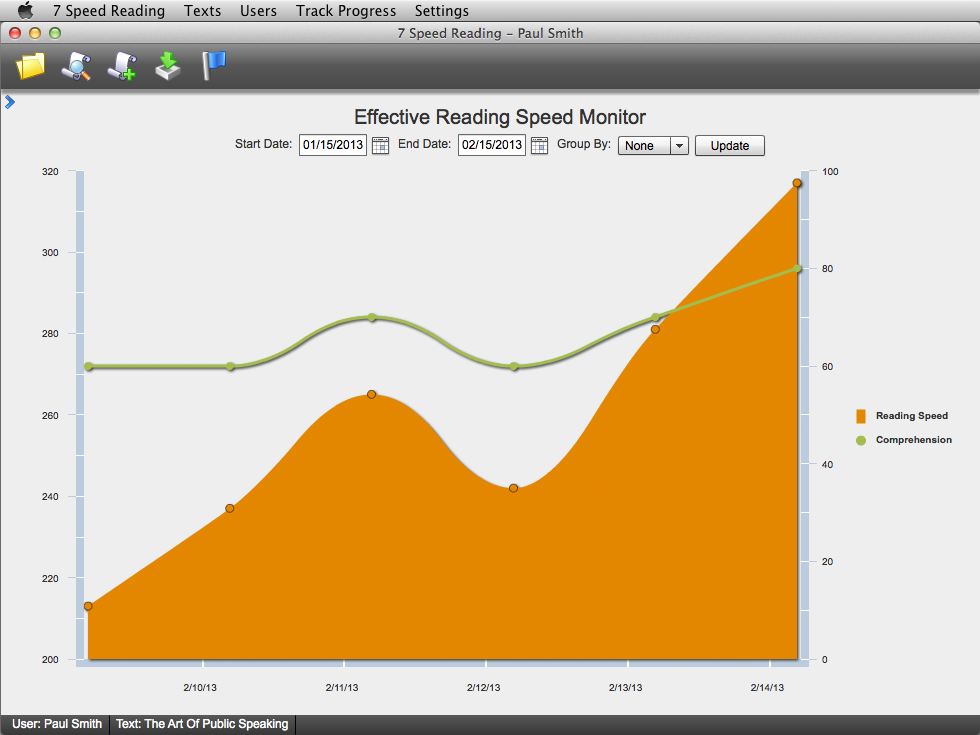
See Yourself Improving


See Yourself Improving

You are motivated and rewarded because you can see your results.

Personalized Instruction


Personalized Instruction

Each time you use it, 7 Speed Reading records detailed data on your learning. This means that each activity is always customized to your current needs.

Keep Track


Keep Track

Keep track of time invested – and see how a few minutes can translate into a measurable boost in reading speed and comprehension.

Any Wiki Article


Any Wiki Article

With 7 Speed Reading, you can learn to speed read using any Wiki article. Triple your reading speed while you discover amazing facts.