
Personalized Instruction
Each time you use it, 7 Speed Reading records detailed data on your learning. This means that each activity is always customized to your current needs.

Speed Reading For Education
7 Speed Reading EDU is the world's most advanced accelerated reading system for schools. Based on proven principles of faster reading, 7 Speed Reading EDU contains all the features of 7 Speed Reading plus:
The next step is to see 7 Speed Reading for yourself. Simply fill out the form and we'll send you a free no obligation trial of the full version of 7 Speed Reading EDU.
speedreadingtechniques.org
Elbert Zeigler
courselounge.com
Daniel Walters
winningspirit.com
bestadvisor.com
Stephen L. (Reviewer)
Devad Goud
Reinard Mortlock
Adel Serag
Nik Roglich
Jose Godinez


Each time you use it, 7 Speed Reading records detailed data on your learning. This means that each activity is always customized to your current needs.
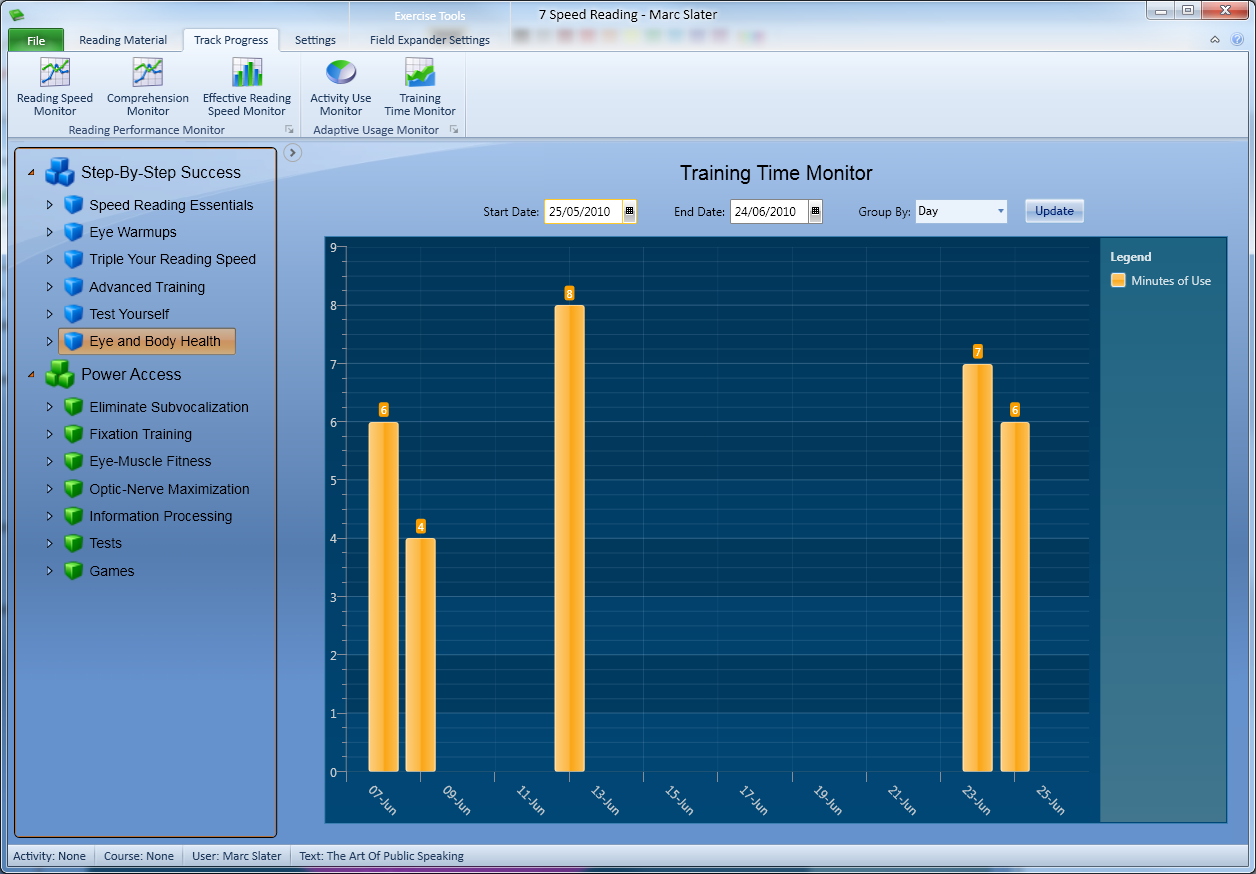
Keep track of time invested – and see how a few minutes can translate into a measurable boost in reading speed and comprehension.
As long as there has been a written alphabet, and printed books, people have been interested in becoming better readers. However, it wasn’t until the 19th century that people started looking at reading from a more scientific standpoint, and applying science to the art of reading in order to create speed reading techniques. The 7 Speed Reading software system is based on the latest in scientific research related to the theory and mechanics of reading, which is why it’s so effective in helping you increase reading speed.
There’s a solid foundation of research to build on, going back to 1878, when French ophthalmologist Louis Émile Javal discovered and described the saccade/fixation pattern we all have when reading. That is, even though we think our eyes are moving smoothly along the line of text, they’re actually making jumps (saccades) and stops (fixations) as our eyes focus on one or more words, process the text, and move on. Part of a good speed reading strategy is to learn to increase the number of words processed in each fixation, so that there are fewer saccades.
By the first part of the 20th century, speed reading became a common topic in popular science as well as in the educational field. Books like Edmund Burke Huey’s 1908 publication The Psychology and Pedagogy of Reading discussed “the possibility of reading without inner pronunciation” (subvocalization) and helped form part of the curriculum at the University of Pennsylvania. Along with other researchers in universities around the United States, he explored the “peculiar fatigue occasioned by reading” and “the great variations and limitations in speed of reading [which] suggested possibilities of improvement,” which he grouped under the heading of “reading hygiene.” In other words, the discussion had started about how the reading environment and other physical considerations might affect the mental process of reading.
It seems sometimes that humanity can turn anything into a matter of war and defense, and speed reading was no exception in the 1940s and 1950s, when the US Air Force used a tachistoscope (a device that displays images at a specific rate) to conduct experiments with words flashed on screen for only 1/500th of a second each, eventually proving that even at that rate reading comprehension is possible. Many of the later speed reading courses incorporated this theory, but since portable tachistoscopes weren’t available on every street corner, a different method needed to be found to create practical image-flashing techniques into speed reading programs. In 1959, that’s what Evelyn Wood did with her Reading Dynamics program, by recommending the use of the hand, fingers, or pieces of paper to create a similar pacing and tracking method. Combined with other techniques to help eliminate backtracking, the Reading Dynamics program became the most popular speed reading course in the world.
Today, with all of the technology available, we’re closer than ever to finding the best ways to combine science and practical methods to develop the best speed reading practices. Computerization and miniaturization are leading to innovations in text presentation, and online speed reading courses open up the skill to anyone with a computer. With all the good information out there, it’s always the right time to let your speed reading skills take you into a successful future.
The more you read, the better you’ll be at reading. As we discussed in a previous post, there are several reasons why people who read a lot are more likely to be speed readers:
– they know more facts, so they don’t have to struggle to learn new information
– they know more vocabulary, so they don’t have to stop and look up words all the time
– they’ve exercised their brain and eyes and are in top reading shape
– they’ve learned all the speed reading techniques and use them daily
Because these benefits come from reading a wide variety of books, and from reading a lot of books, in order to be a top speed reader you need to have access to entire libraries at a moment’s notice. Thanks to modern technology, you’ve got it. As long as you have an e-reader, you’ll be able to download ebooks any time, on any subject, and get all the advantages you need from the text.
Free ebooks are available through most libraries these days, though in general you still need a library card and number, and there might be a charge for that. Usually, you’ll have a choice of formats, so even if you don’t have a separate e-reader like a Kindle or Nook, you’ll be able to download the book. Some books are also offered in an audio format, and while listening to a book isn’t going to necessarily help your speed reading practice, it’s useful to have the print book and follow along to help you overcome the habit of backtracking.
Amazon offers a free Kindle app that you can download to your laptop, if you don’t want to have a separate device just for reading. There are also lots of free ebooks available through Amazon’s sites, ranging from modern authors who want to attract an audience to older books now in the public domain that have been converted into electronic format. These “public domain” books are also available through free ebook sites like Project Gutenberg or the University of Pennsylvania’s Online Books Page.
With all the wealth of the world’s libraries at your fingertips, what are you waiting for?

The exercises remove your bad reading habits, making it easy to read 3 times faster with improved comprehension.
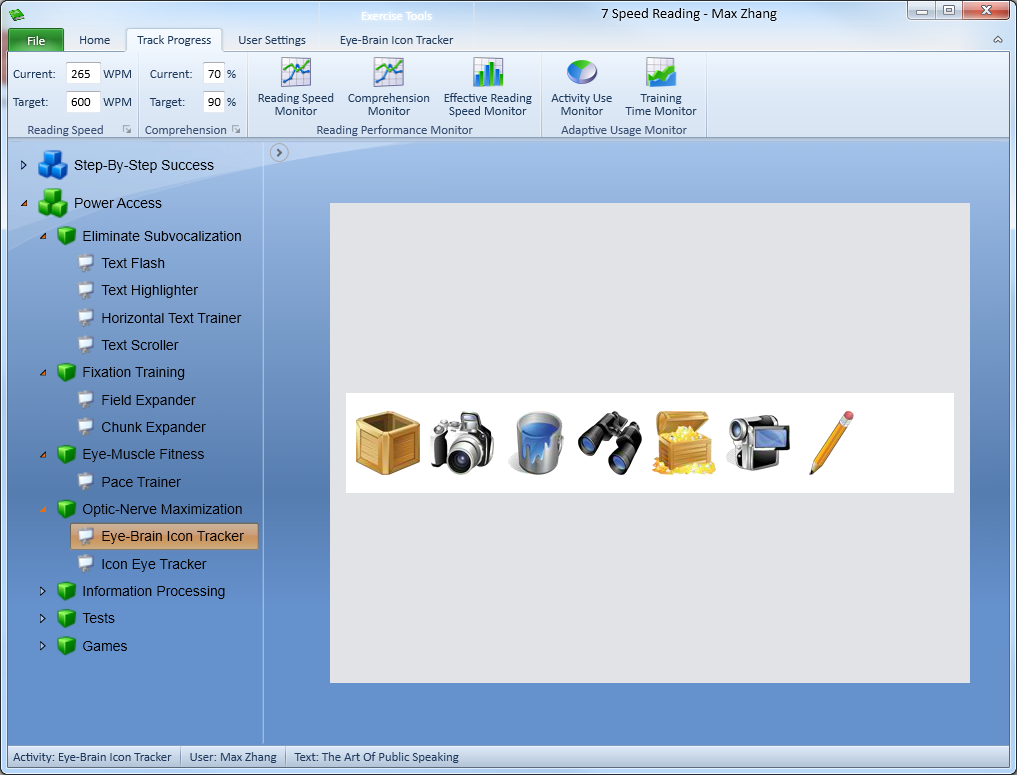
Scientifically designed computer exercises remove your bad reading habits automatically.
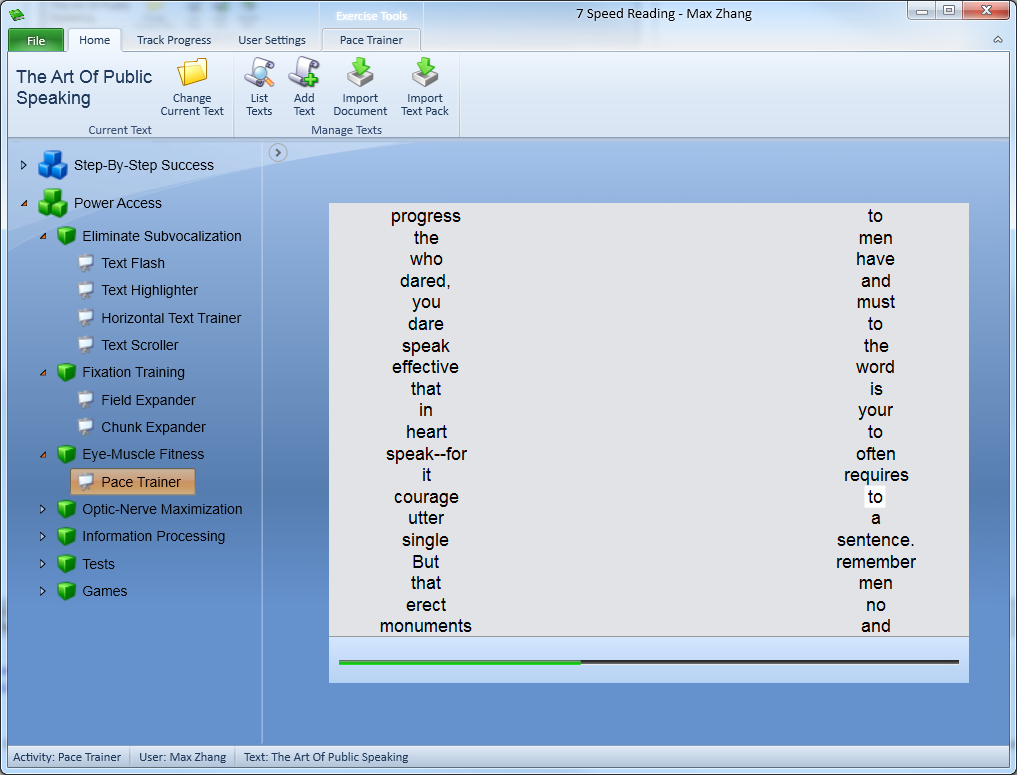
7 Speed Reading is the only program to train you in all the areas you need to maximize your reading speed, comprehension, and memory.

Your personal coach takes you by the hand and helps you at every step. Learning to read 3 times faster is now easy for everyone.
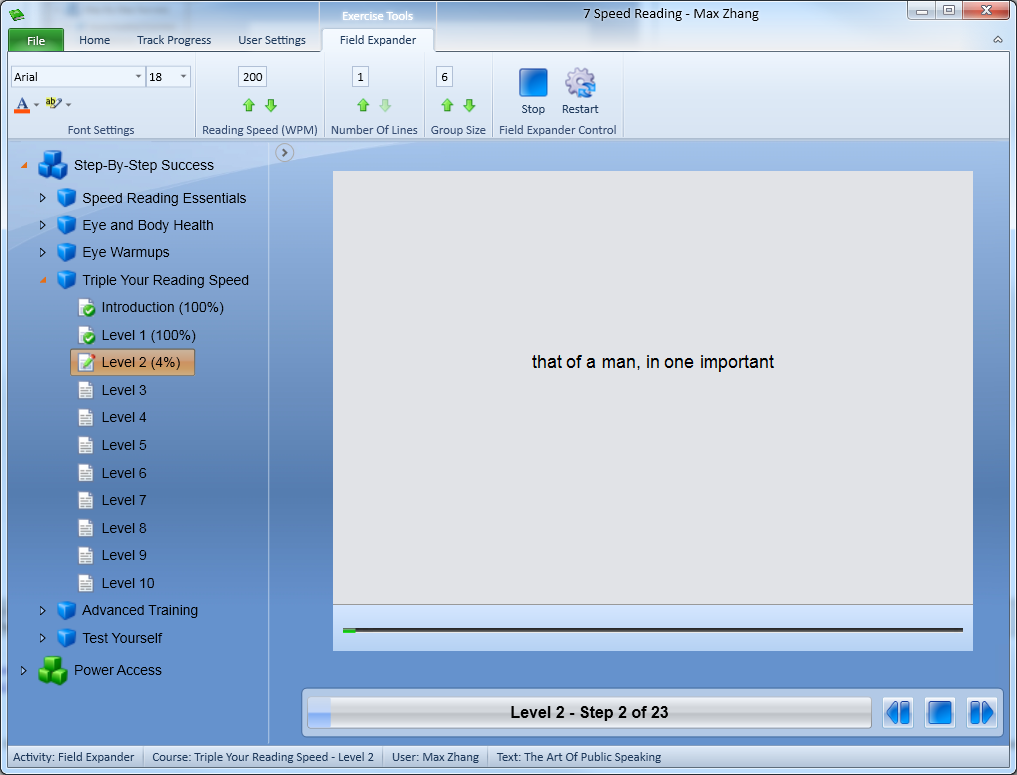
Each exercise is customized to match your unique needs. Your personal coach makes sure you’re progressing at the right rate to achieve your goals.
Ultimate Typing produces the industry’s only legally verifiable typing certificates