
Speed Reading For Education

7 Speed Reading EDU is the world's most advanced accelerated reading system for schools. Based on proven principles of faster reading, 7 Speed Reading EDU contains all the features of 7 Speed Reading plus:

The next step is to see 7 Speed Reading for yourself. Simply fill out the form and we'll send you a free no obligation trial of the full version of 7 Speed Reading EDU.

speedreadingtechniques.org

On the pro side it has easy-to-use interface, video tutorials, multiple user accounts, well-structured course system for beginners & advanced students plus the ability to exercise with any digital text.

Elbert Zeigler

"I found 7 Speed reading. Doing eye exercises, warm-ups before reading, and how to look at words in groups instead of one at a time improved my reading and comprehension. I recommend 7 Speed Reading for you."

courselounge.com

7 Speed Reading is a decent speed reading software with an innovative approach. The customizable features are quite appealing since it allows you organize your speed reading training effectively.

Daniel Walters

"I have always struggled with reading slowly. Once I started using 7 Speed Reading, I did notice an improvement from approx. 200 wpm to 300 wpm."

winningspirit.com

If you want to learn how to speed read so that you can read everything faster, your best option is to get the self-paced speed reading course called 7 Speed Reading. It is designed to be the world’s most powerful speed-reading training program.

bestadvisor.com

From learning how to read and comprehend faster to how to keep your eyes healthy, everything is covered in this course for almost any age, and a team of professionals will help you master it.

Stephen L. (Reviewer)

I liked the accessibility of it. It helps, because users are able to easily maneuver throughout the software to varying levels and practice their reading at varying speeds.

Devad Goud

After having used this software, I learned techniques and skills such as eliminating my subvocalization, which not only greatly enhanced my speed reading, but also allowed me to get more engagement in what I read.

Reinard Mortlock

The biggest problem I had was sub-vocalization, 7 Speed Reading helped a lot with techniques to improve this and substantially improve my reading speed. The application is easy to use with loads of books to read to improve your reading skills.

Adel Serag

When I seriously exercise using the app, in no time, my reading speed goes from less than 400 to 600 and my target is 900 plus.

Nik Roglich

The pace trainer is great for getting my eyes focused and sharp. Also the word search exercise is very important, gets me searching for specific text.

Jose Godinez

I have improved my speed reading and comprehension since I started using 7 Speed Reading, I enjoy using it and I will continue to use it in the future.

Spring Ahead In Your Reading With New Vocabulary


Whan that aprill with his shoures soote
The droghte of march hath perced to the roote,
And bathed every veyne in swich licour
Of which vertu engendred is the flour;
Whan zephirus eek with his sweete breeth
Inspired hath in every holt and heeth
Tendre croppes, and the yonge sonne
Hath in the ram his halve cours yronne,
And smale foweles maken melodye,
That slepen al the nyght with open ye
(so priketh hem nature in hir corages);
Thanne longen folk to goon on pilgrimages,
And palmeres for to seken straunge strondes,
To ferne halwes, kowthe in sondry londes;
And specially from every shires ende
Of engelond to caunterbury they wende,
The hooly blisful martir for to seke,
That hem hath holpen whan that they were seeke.
– Prologue to “The Canterbury Tales” by Geoffrey Chaucer (c. 1400 CE)

Unless you’re already a student of English literature, you probably had a hard time reading this excerpt at your usual speed. That’s because it’s full of words you don’t know – or rather it’s full of words you do know, but they’re all in their Middle English spellings. For example, “shoures soote” actually means “sweet showers” (as in rain showers, common to English springs past and present). Once you do know the words and can recognize them, suddenly reading even this archaic text is easy. We’ve used this as a somewhat extreme example of an important aspect of speed reading practice: vocabulary development.

Every time you come across an unfamiliar word when you’re reading, it will slow you down. If you can’t understand the sentence or paragraph because you don’t know the word, that slows you down even farther. Sometimes it’s easy to figure out what a new word means, and other times the rest of the phrase is clear enough that you get the sense of what the author is saying even if you don’t know the exact definition of that unfamiliar word. However, if you have to look up a word to continue, or worse, take the time to re-read a section of a document so that you can understand what it means, your reading speed will suffer.

The more words you know, the faster you’ll read. It’s as simple as that. When you come across a word you don’t know, invest a minute or two into looking it up and learning it. That’ll save you time in the future when you encounter that word again. A better vocabulary helps you read more quickly, which means you’ll find even more new words, which will in turn give you the power to read faster still. When you improve your vocabulary, you’re becoming a better speed reader at the same time.
Tomorrow is Another Day … For Speed Reading Practice


“Don’t look back, Ashley, don’t look back. It’ll drag at your heart until you can’t do anything but look back.” – Scarlett O’Hara, in the 1939 film version of “Gone With The Wind”

That’s sound advice for many aspects of life, but particularly applicable to practicing your speed reading skills. One of the bad reading habits that many people develop is regression, or “looking back” at text that they’ve already gone over, whether they need to or not. There are several reasons for this habit:

– Their early reading teachers stressed the importance of making sure they read all the text.
– They aren’t focused , so they forget the text at top of the page by the time they reach the bottom.
– They don’t trust their reading skills, so re-read “just to make sure.”

When you first learned to read, you probably were reading words one at a time, but even then your eyes and brain were processing the text on the page more quickly than you realized. If you’re even an average reader, you’re unconsciously taking in more information that you’re consciously aware of. Take advantage of the power of your brain and relax – you don’t have to work as hard as you think you do to be a fast reader.

You do, however, need to stay focused. Developing your power of concentration and attention will help you in more than your speed reading practice. Another way to keep your focus on the text is to “look ahead” before you start reading, and take a few minutes to think about why you’re going to read that particular document. Are you looking for something specific, a fact or set of figures, or just overall general information on a topic? If you keep the goal of reading in mind while you read, you’ll find it easier to focus on the text.

As Scarlett O’Hara said, when you spend too much time looking back you’ll forget how to move forward. If you catch yourself re-reading text automatically, work on breaking the habit by covering the text or pages you’ve already read, or keeping your hand off the “back” button or scroll bar. Don’t let the habits of the past keep you from the speed reading future you deserve!

3 Ways to Use E-Readers For Faster Reading


Having the ability to download and carry thousands of books with you on your notebook, laptop, or e-reader is one of the many benefits of 21st century technology. More and more people are taking advantage of this technology; according to a recent Pew Research Center study, 21 percent of Americans say that they read an e-book during the previous 12 months. Even more people – especially younger ones – use e-readers or other devices to read online magazines, news articles, or journals. And the most exciting findings from this study show that people who read e-books are also reading more books overall. According to the researchers, the average e-book reader goes through 60% more material than someone who doesn’t use an e-reader: 24 books per year, rather than 15.

One reason why e-book readers might be able to read more books is that they can do it at a faster rate. Using an e-reader provides several opportunities for working on speed reading skills. Here are three ways you can use e-books to improve reading speed:

Eliminate the tendency to reread by using scrolling. One of the habits that many people get into is “looking back” at what they’ve already read, either because they weren’t focused on the text the first time, or they aren’t confident that they understood what they read. However, if the text you’ve already read is no longer visible, your eyes won’t automatically flick back to that section. Learn how to focus on the text and eliminate this habit by using the scrolling feature on the screen when you can. Keep the text you’re reading at the top so that it disappears as you scroll. If you have to go back to find information you missed, you’ll be able to do that, but you won’t slow yourself down by unconsciously re-reading text you don’t need to review.

Improve your ability to process more words at once. Another bad habit many people carry over from their first attempts at reading is taking each word one at a time. Once you know how to read, your eyes and your brain can actually handle multiple words at the same time – as long as you trust them to do so. Speed reading depends on the ability to “clump” words into groups, and you can practice this by changing the display column width on your e-reader. Bring the margins in so that only 5 to 10 words appear on each line, and widen your visual focus so that you’re reading each line as a group.

Expand your vocabulary and your reading skills. As we said earlier, one of the big advantages of e-readers is the ability to access thousands of different books on a variety of topics. When you read a lot, and read a lot of different things, you’ll get a bigger vocabulary and better overall knowledge on a range of subjects. The more you know, the easier and faster it will be to read new texts, because you won’t have to stop and look things up.

If you’re interested in more results of the Pew Research study on e-readers, click here.

5 Factors For Reading Success


If you’re already an avid reader and are just working on further increasing your reading speed and comprehension, congratulations! You know how much better you’re able to get through your workday in an efficient manner, and you enjoy being able to read a variety of fiction and nonfiction books from the wealth of resources from your local library or e-book store. But if you’re not someone who finds reading easy, or if you’re a parent who’s concerned about making sure that your child has the reading skills they need to succeed, then these five factors for reading success are important things to keep in mind.

1. Read what you like. When you’re struggling to read, having to deal with uninteresting topics makes the process even harder. This is especially important for children, but it’s also very easy to let kids choose what they want to read in the beginning. Adults will also benefit from starting with familiar, enjoyable material. If you’re working on basic reading skills, make it as fun as possible – there will be time later to work on handling more difficult texts.

2. Make sure you understand what you read. A book that you picked because it’s about your favorite sport fits the “what you like” factor, but if it’s written using unfamiliar words, it might still be difficult. Take the time to look up words and make sure that you comprehend one section before moving on to the next one. Parents and teachers can help children by asking questions about the material in a non-judgmental way, and without putting pressure on the child to read faster. Like any skill, reading ability will grow stronger over time.

3. Review vocabulary and information by writing about what you read. Good reading skills are built on a good vocabulary and a good grasp of facts on a variety of topics. The more you know, the better and faster you’ll be at reading texts. One of the best ways to make sure that the words and facts stay in your memory is by writing a short summary after you’re done with the text, using the new words you’ve learned.

4. Talk about what you read with other people. Like a written review, conversation about a book you’ve read will help keep it in your memory. What’s more, you’ll find that it’s fun to talk about books with other people. Look for book groups in your area and expand your social life as well as your speed reading skills.

5. Read aloud to children. When you read to a child, and have a conversation about the book with them, you’ll encourage good reading habits at an early age. You can also have an older child read aloud to you, giving you the opportunity to help with pronunciation. The earlier a child begins to work on their reading skills, the better chances they’ll have in school, which will give them the advantage in higher education and careers down the road.

Speed Reading: How To Ace Your Entrance Exams


Unless they’re an academic prodigy, a student probably won’t take tests like the SAT (originally called the Scholastic Aptitude Test), the LSAT (Law School Admission Test), the GRE (Graduate Record Examinations), or even the GED (General Educational Development, a North American high school equivalency text) until they’re at least 16 or 18 years old. However, preparation for these tests starts months or even years ahead of the actual test date, as students repeat and review information, and learn new vocabulary, and brush up on their math skills. There’s a lot of pressure on students to get high scores – a good score can lead to acceptance by a top university, or provide the edge the student needs to beat other applicants in the race for a limited number of spots in law school. But there’s also something that helps reduce some of this pressure: the skill of speed reading. If you’re planning for these tests in the future, you should start practicing speed reading now.

In order to succeed on tests like these, you’ll need to have a good general knowledge of math, science, literature, English grammar and spelling, history, and sociology. The tests are famous for providing examples and asking questions on many different topics, and the more you know, the easier those questions will be for you. When you’re a speed reader, you’ll have the time to go through more texts on more topics, and your speed reading skills will help with comprehension and memorization as well. Better reading comprehension skills mean that even if you’re presented with an essay question on an unfamiliar subject, you’ll be able to read and respond clearly and coherently.

Another part of test-taking success is time – the time you need to read the questions, as well as the time you need to write down the answers. The faster you read, the quicker you’ll get to the “answer” part of the equation. This is especially important when you have comprehension or essay questions, because the extra time you gain by moving quickly through the multiple-choice sections due to your fast reading speed can be used for thoughtful reflection on the longer written essay answers. You’ll even have time to spare to go back over your answers to double-check that you’ve gotten them right.

Don’t wait until the last minute to develop your speed reading abilities! Even if you’ve already passed the tests and are moving forward in your career, you’ll find that speed reading has benefits that will help you succeed for years to come.

Will New “Common Core Standards” Improve Your Child’s Reading Skills?


“How can we provide a good education for our children?” is a question asked by parents and politicians alike. Naturally, teachers have their opinions on the educational process, too – in fact, we’ll bet that you won’t find anyone who doesn’t have something to say about school quality or student achievement, whether that’s talking about their own experiences or what they think of “kids these days.” In the United States, the “No Child Left Behind” program was designed to raise the overall quality of education, by requiring schools to meet strict testing standards. In other words, if too many students tested in math and English skills failed to score highly enough, that school would be required to change its teaching practices, or replace its teachers, or even close down. A lot of argument has gone on over the last ten years about whether this approach has been working. Teachers complain that they’re required not to educate students, but instead to make sure they know how to pass the tests. That’s a superficial education, they say, and maybe not an education at all. Think about the difference between learning that 1492 was the year Columbus arrived in the Americas, and learning all about the political situation in Europe during this time of global trade and conquest as France, Spain, Portugal, The Netherlands, and England fought over territory around the world. If you only know the date, you might be able to answer a multiple-choice test question correctly, but you wouldn’t be able to write an answer to an essay question about why Columbus sailed for the New World.

In answer to some of these complaints, a new program called “Common Core Standards” has been developed and is being implemented across the United States. It’s designed to focus as much (or more) on the why of information as the what, according to its promoters. As part of the new system, reading skills will get a new focus. Teachers will work on getting students to read more deeply, to think about what they’re reading, and to be able to talk and write about the text. They’ll use both fiction and non-fiction in their classes, rather than fiction alone, to give students the opportunity to think about real-world situations and issues as well as literary devices, characterization, and plot. For some teachers, adjusting to the new standards has been difficult, because they have had to change lesson plans they’ve been using for years. Other teachers disagree with the use of third-party materials from businesses who are creating “ready-made” lesson plans and examinations, saying that these often fall back into the trap of “teaching to the test” with only one right answer possible, even in a case of opinion-based literary analysis.

Naturally, it will take a few years to see how this new system works, and whether it does have a positive impact on children’s reading skills. The theory is good – it’s always better to think about what you’re reading, rather than just skimming it and forgetting it – but it will take time to see how the Common Core program works in practice.

Does your child’s school use the Common Core program? Let us know what you think.

How Reading Boosts Your Brain Into High Gear


Recent studies using high-tech tools that measure brain activity show that when you read more complicated texts, with words that are unfamiliar or used in unexpected ways, the electrical impulses in your brain increase. In a sense, it’s like a “rocket boost” for your brain, according to Philip Davis, an English professor and one of the team of researchers who are examining this phenomenon at Liverpool University. New vocabulary words set off a spark, so to speak, as your brain tries to “illuminate” the blank space that needs to be filled in with the word’s meaning. Think of the word clarify, which has its origin in the Latin word clarus (“bright, distinct”). The light that goes on in your brain when you solve a puzzle or find an answer to a problem isn’t just metaphorical – there’s actually energy flowing around in this process, just as when electrical power lights up a lamp bulb.

Many studies have also shown that when multiple areas of the brain are active at once, a person’s ability to learn and remember are increased. The Liverpool University project clearly shows that when people read more difficult texts, it stimulates activity in more than one segment of the brain. When your brain is fully awake and active, that’s the best time to learn new vocabulary words. As soon as you come across a word you don’t know, look up its meaning and pronunciation, and spend a few minutes saying it out loud and practicing it. If you can’t do that, jot the word down and look it up as soon as possible. Take advantage of all the energy that’s available to you to focus on adding that word to your working vocabulary, and you’ll find that it’s easier to remember in the future.

What’s more, each new word that you learn and are able to remember will help you increase your reading speed. One of the things that slows down people who want to be speed readers is a lack of vocabulary words. If you have to stop and look words up all the time, you’ll naturally read more slowly. Worse, if you skip over words you don’t know, you might misunderstand the text, and that will cost you even more time as you clear up confusion, or reread the text, or both.

So the next time you’re looking for something to read, make your selection from classical literature, or a work of nonfiction on a topic new to you, or anything else that you know will challenge you with new words, and you’ll soon find that both your vocabulary skills and your speed reading skills will improve.

Cross-posted in The Vocabulary Builder’s Blog.

How to Improve Peripheral Vision


In the last post we talked about changing the margins of an online document to make it easier for you to learn how to group words, or “clump” them, so that your eye takes in words in multiples, rather than one at a time. Today we’ll talk about how you can use that same technique with paper documents, but in a slightly different way. Rather than focusing on improving your ability to take in multiple words at the same time by reducing the number of words on the line, this margin-adjusting exercise helps you expand your peripheral vision, which will allow your eyes to absorb larger groups of words even on normal-length lines of text. In order to do this exercise, you’ll need a paper document you can draw lines on (not a library book, obviously!). Find a document where there’s only one column of text on the page, not a magazine or newspaper where the text is already divided into narrow columns.

Expanding the range of your vision will require both concentration and relaxation. To help you concentrate on the exercise, you’ll need to indent the margins of the text to provide guides for your eyes. Draw a straight line about 1/4 to 1/2 inch in from each outside margin running from the top of the page to the bottom, on both sides. As you read, let that be the limit of where your eye stops left and right, rather than moving your eyes from the very beginning to the very end of the text on each line.

Here’s where the relaxation comes in: you’ll need to trust that your peripheral vision will pick up the words that are to the outside left and right of those penciled-in margins. After you read a page of text, stop and think about what you read and go over it in your mind. To check that you didn’t miss anything, go back and read the page while ignoring the margins you drew. We’ll bet that you’ll soon realize that even if your eyes weren’t focused on the words on the edges of the page, your brain picked them up anyway, or was able to fill in the meaning if the missed words were unimportant ones.

As your peripheral vision gets better, bring in the lines by 1/2 to 1/4 inch at a time, until your comprehension review shows that you’ve started to reach the limit of your peripheral vision. Keep practicing, and you’ll be confident that you’re able to get the most out of every document with the least amount of eye movements, a key element in speed reading technique.

Narrow Your Focus, Expand Your Understanding: 3 Speed Reading Tips


Comprehension is the goal in speed reading, just as much as actual words per minute. After all, if you don’t understand what you’ve read, you won’t be saving any time at all when you have to go back and re-read text to get the information you need. There are several things that you can do to make sure that you’re not skipping over vital material when you’re reading, so that even as your reading speed increases, you’ll still be able to find and remember the facts and figures that you need from the text.

Focus your attention on what you’re looking for. You might think that speed reading’s just a matter of training your eyes to quickly scan text, but in fact you’re really training your brain to quickly process the information that your eyes are taking in. In order to make your brain more efficient at this task, prepare yourself for reading before you even pick up the document. Ask yourself what it is you need to find in the text, or what questions you need answered, or what specific sets of detail you need to look for. By prompting and preparing your mind to be actively looking for this information, you’ll make sure that you don’t accidentally skip over it.

Learn how to best focus your eyes. To be the best speed reader possible, you need to be able to take in groups of words, not just single words. A good way to practice learning how to do this is to make whatever you’re reading into a prepared set of grouped words, by changing the margins of the text. Obviously, this will only work with on-line documents, but it’s a useful exercise. Increase the margins on the document so that the words are in a narrow column approximately 5 or 6 words wide down the middle of the page, and try to take in each group of words line by line as you read.

Devote focused practice time to speed reading. Just like any other skill, speed reading takes practice. If you want to be the best basketball player possible, you’ll spend hours practicing your free throw shots. Repeating these motions over and over will eventually give you smooth, fast, and accurate hoop skills. If you practice your speed reading techniques with the same focus and concentration, you’ll quickly get the same results.

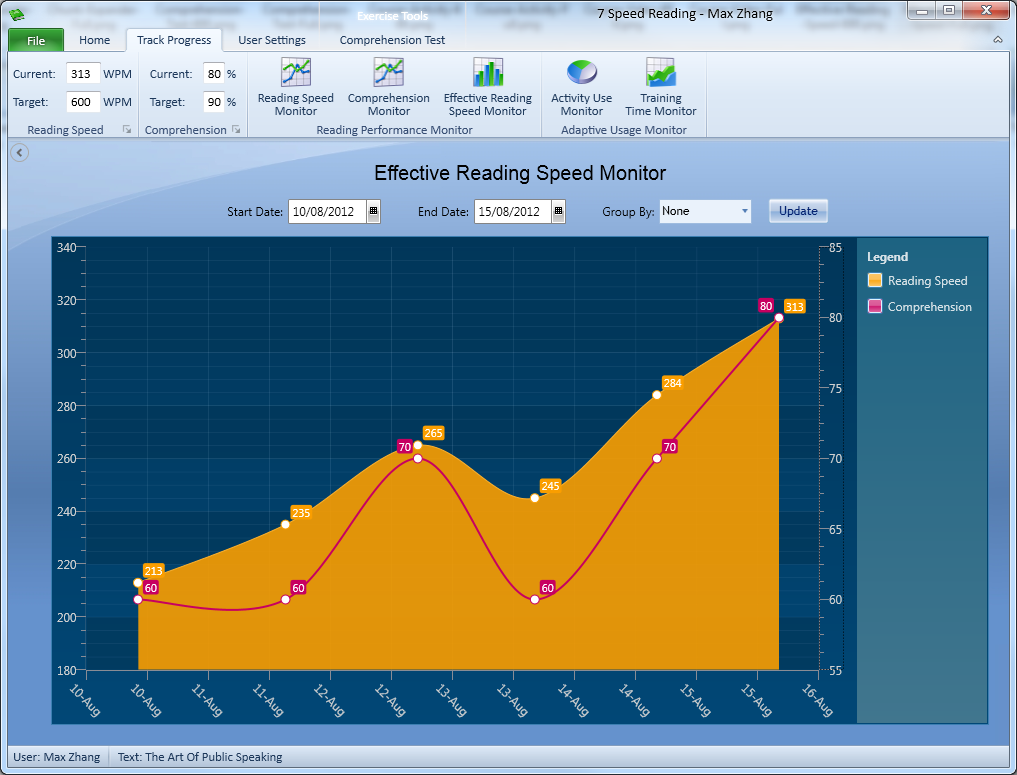
See Yourself Improving


See Yourself Improving

You are motivated and rewarded because you can see your results.