This Video Will Educate You How Temperature Has Increased In The Past and Its Effects of the Future
“Earth right now: Your planet is changing.”
Visit NASA now and let’s start saving our planet!

Speed Reading For Education
7 Speed Reading EDU is the world's most advanced accelerated reading system for schools. Based on proven principles of faster reading, 7 Speed Reading EDU contains all the features of 7 Speed Reading plus:
The next step is to see 7 Speed Reading for yourself. Simply fill out the form and we'll send you a free no obligation trial of the full version of 7 Speed Reading EDU.
speedreadingtechniques.org
Elbert Zeigler
courselounge.com
Daniel Walters
winningspirit.com
bestadvisor.com
Stephen L. (Reviewer)
Devad Goud
Reinard Mortlock
Adel Serag
Nik Roglich
Jose Godinez


This Video Will Educate You How Temperature Has Increased In The Past and Its Effects of the Future
“Earth right now: Your planet is changing.”
Visit NASA now and let’s start saving our planet!


Sean M. Kelly
When someone is a living example of the skills they’re teaching, you can have confidence in their ability to help you gain those same skills. Seán M. Kelly helps people all over the world to make the most of their abilities, focusing in particular on ways to improve mental focus, memory, creativity, and learning power.
7SR: You’ve obviously been interested in making the most of your own mental abilities for many years; you graduated with an Honours degree from Trinity College in Dublin. How do your early studies in the fields of physics and mathematics connect to your current work with mental performance?
Great question. Possibly one of the greatest lessons I’ve learnt on learning and mental performance goes back to my college days studying for my degree in Physics and Mathematics, albeit not directly related to physics and mathematics.
One day I was studying hard for exams with my old inefficient way of studying – I would spend hours and hours going through notes and books by making shorter summary notes to revise later. I would “hope” by doing this the information was going into my brain! This is the way many of us study and we think as long as we’re putting the hours in we’re studying! Of course to some degree it did work as I did achieve an honours degree in physics and mathematics but I soon learnt there were far easier and more effective ways of doing it!
One day my Father came into my bedroom where I was studying and says here’s a great book on studying which may help. It was called “How to Study Effectively”. It had chapters in it on setting study goals, mind mapping, memory, speed reading, time management and the other effective study techniques. I looked at the cover and the contents and said “Great thanks Dad”. After he left my room I put it on my book shelf to look at later. There it stayed until after my exams!
When I left college and entered the corporate world I soon realised that the time we had for learning skills in college was far far more than we would get working for a corporation. In college we would study a computer language for a year, in the corporate world we were given a week! I had to learn new ways of learning and fast. That’s when I started looking into what was in the book my Dad had given me while I was in college. I soon realised how helpful it would have been in college but also realised it would be very helpful now in the corporate world too! It also formed a basis of a growing interest I have in the areas of learning and mental performance.
7SR: You’re also a musician and author, which is something people might not expect, given your background in more “left-brained” areas like IT. How have you learned to access your creativity, and what do you tell people who are looking for methods that will help them unleash their own inner artist?
First and foremost my belief is that everyone has infinite creative abilities. They may need a bit of exercise but they’re within us all. I also inform people about different models of our brain and how it works. One of these explores the power of beliefs and how they limit or un-limit us. Another one demonstrates how to cultivate whole brain thinking – that is using both sides of our brain, the logical and the creative. Another one explores how managing our emotions can limit or free us. After these models are explored I show people techniques that we can use to free up our creativity such as the Da Vinci technique, the Disney technique, random word association and indeed we create some of our own on the courses too.
7SR: You work on developing a person’s ability to use the assets found in both their subconscious and their conscious mind. Is learning to speed read something that people need to do consciously, or is it more of a “learned unconscious” process?
Learning any new skill will usually involve some conscious learning and then that goes into the subconscious so we can do it in “autopilot”. If any of us think back to when we first learnt to read, we can recall it was a conscious process. We first learnt to recognise letters, then recognise patterns of letters that made up words, then memorised what those patterns of letters meant. When we were learning to read we’d look at each letter in the word and from that aim to recall what the word meant. Now when we look at a word we don’t have to look at each letter consciously but we do look at them subconsciously, at least most of the letters so we recognise what the word means. In much the same way, learning to speed read would first be a conscious process and then with practice it becomes subconscious – we can do it in “autopilot”.
7SR: What’s the connection between accelerated learning and speed reading?
Basically speed reading is one of the skills that is used to accelerate our learning. Other skills include mind mapping, improving our memory and recall, creativity, goal setting, time management and others.
All of these techniques and others come together to form a generic strategy for Accelerated Learning which when applied can make our learning a lot more effective, easy and enjoyable!
7SR: You’ve had very respectable placements in past years at the World Memory Championships. Are you planning on competing again?
Yes I was 8th in the world in 1997, 12th in 1998 and 51st in 2012.My intention is to compete in the future alright. As you need a lot of time to prepare and practice we’ll see can I schedule it.
My main focus at the moment is on sharing what I’ve learnt with thousands of other people in global organisations, colleges, schools and even very young kids around the world! In the past couple of years alone I’ve travelled extensively to such countries as the USA, Luxembourg, Belguim, the UK, Poland, the Czech Republic and of course delivered a lot in my home country of Ireland. I’ve trained in excess of 10,000 people from many different cultures. One of the reasons I’ve partnered with eReflect with the Speed Reading course is to offer these skills and techniques to many more organisations and people globally.
About Sean Kelly
A leading international expert on how to use more of your minds infinite potential, Sean M Kelly trains and coaches organisations and individuals to greatly improve their performance by learning more about their mind!
7 Speed Reading™ teaches you how to read faster through seven strategies proven to increase your reading rate and comprehension.
Bloggers, editors at compare and contrast sites, and language specialists have all offered an assessment of the program, and these reviews will help you understand the software’s true power to help you read more efficiently.
Vagueware: “The best among the rest”
For Vagueware no other speed reading program can match the effectiveness of 7 Speed Reading™. The reviewer of no less than 10 speed reading programs places 7 Speed Reading™ at the top, saying,
“With the best methods and materials, extensive lineup of features, excellent reporting tools, and help and support options, 7 Speed Reading remains the top speed-reading software. It does not only train you to boost up your reading speed but also enhances your comprehension, vocabulary, memory, focus, and overall mental and physical acuity.”
Vocabulary.co.il: “Stands Apart”
Vocabulary.co.il considers 7 Speed Reading™ to be the best program available, and one that cannot be matched by other programs such as Rocket Reader and the Reader’s Edge. Vocabulary.co.il explains,
“It is one of the most comprehensive programs. With this software, there is a broader range of techniques offered to help the user achieve speed reading success. These various aspects allow for the fact that different people have different learning styles, and as such, they need diverse strategies in order to fully succeed at mastering speed reading.”
Software Review Boffin: “1st place winner”
For Software Review Boffin, 7 Speed Reading™ is an industry leader. After a thorough review of eReflect’s program and competing software EyeQ and Ace Reader, Software Review Boffin awards 7 Speed Reading™ their Gold Five-Star award for excellence and quality.
The reviewer’s verdict illustrates the high regard this software earned, noting,
“7 Speed Reading manages to combine all of the best points of every other speed reading software, and then some, into one package that is easily usable by anyone and best of all, actually brings about positive results in a short amount of time.”
Typing Lounge: “Attractive” “Comprehensive” “Rich”
Typing Lounge creator Mark Ways offers a detailed comparison of the top speed reading improvement programs for 2015, and agrees with the previous reviewers’ verdicts, that 7 Speed Reading™ is ahead of the pack.
The 2015 release of 7 Speed Reading™ comes packed with coveted features like cloud technology, social media integration, and group learning functionality. For Mark Ways, the program is the most complete and enjoyable solution for anyone wishing to improve their competitive edge through faster and more efficient reading. He concludes his evaluation by saying,
“7 Speed Reading is certainly one of the industry leaders for speed reading software solutions due to its advanced features, proven techniques and group learning functionality.”
Author’s BioFull Biography
We better should learn how to use our words appropriately.
The debate still rages, and the “Reading Wars” are fiercer than ever.
There are those who believe a phonics approach to reading is the solution – that phonics is what children understand and need when first learning to read. And then there are those on the other side, who argue in favor of the whole-language approach to reading: reading that focuses on context and word meaning.
Which is better? What should we be doing when teaching reading to our young students?
The Phonics Approach
Proponents of the phonics approach believe that when you sound out the words you’re reading it gives you the time and stimuli necessary for processing what you’re reading, which provides the basis for comprehension.
A child who uses the phonics approach to reading is expected to be very accurate in how they read and pronounce each word. Attention is given to the proper spelling, pronunciation, and usage of a word, as opposed to its meaning and contextual purpose.
In a phonics-approach classroom, students are explicitly taught the spelling and phonological rules of vocabulary, which they are then expected to apply in the ensuing practice sessions. Ultimately, the student will master the spelling/sound correspondence for words, and will then be able to attach the meaning of the word to that basic knowledge.
The phonics approach is often labeled as a bottoms-up approach. The learner starts with a deconstructed language: they’re presented with the word “cat,” for example, and are expected to break it down to its constituent parts, or rather letter-sounds (in this case, /k, æ, t/). Although this is a rigorous process in many respects, it fails to take into account how a student is to make sense of a word they can pronounce correctly but don’t know the meaning of.
The Whole-Language Approach
Proponents of literacy instruction through the whole-language approach consider phonics an integral part of the method, but certainly not its focus.
Phonics is simply part of a literacy lesson, rather than a lesson on its own. The student is expected to draw on phonics knowledge to decipher the meaning and spelling of words, is also encouraged to use context and prior knowledge to make out its meaning.
In a whole-language approach environment, the reader pays attention to meaning and comprehension first, instead of concentrating primarily on language precision and usage accuracy. What the instructor is after in this methodology is ensuring that they can equip the students with the critical skill of decoding meaning and appreciating the text, by drawing on what they already know, implementing guesswork, and taking into consideration the story’s context and other cues.
While phonics give students a strategy and repertoire for phonetically figuring out new words they encounter, the whole-language approach equips them with a much more necessary skill: that of deciphering meaning through context.
A student who has perfected the sight/sound correspondence will often still be unable to figure out the meaning of a word unless they ask the teacher for the definition, or look it up. That’s why it is important to encourage vocabulary building once phonics knowledge is in place. Ultimate Vocabulary™ helps students improve and expand their vocabulary with fun and age-appropriate activities and games that promote both underlying phonics skills and the more global comprehension that students need.
A student who is trained using the whole-language approach can more easily figure out the gist of a word based on context and prior knowledge. The student is encouraged to read in chunks and not word by word. This meaning-based strategy is effectively used in 7 Speed Reading™ because it helps children as well as adults learners to move away from the word-by-word method and improve their reading speed.
An Argument for a Balanced Approach to Teaching Reading
Phonics is not by itself enough to handle the inherent complexity of English phonology. The words “though,” “drought,” and “tough” look almost the same, but their pronunciation differs considerably.
Guessing pronunciation and/or meaning in this case will only get a student so far. The phonics approach is limited in usability if used alone. The student cannot move ahead if they stumble upon an unknown word. They might read it out loud correctly, but they won’t possibly know what it means.
People who rely solely on the whole-approach method, on the other hand, often don’t pay enough attention to phonics and how crucial it is for reading comprehension and speaking.
A balanced approach that brings the best of the whole-language and phonics approaches together seems to be the ideal solution for helping students master literacy quickly, and as painlessly as possible.
A balanced method of teaching reading considers synthetic phonics as a segment that has to be explicitly taught but not exclusively relied upon by students. The student should be encouraged to use both phonics knowledge and semantic and pragmatic knowledge to decode meaning
Cross-posted on the Ultimate Vocabulary blog.
Have something to add to this story? Share it in the comments
What exactly is literature good for?
1) It Saves You TIME
2) It Makes You Nicer
3) It’s a Cure for Loneliness
4) It Prepares You For Failure

The new year has barely started, and you probably already believe you’ll have no time for reading over the next months. Who can blame you? Between your job, your friends, and the time sinkhole that is the Internet, it’s no surprise that many of us sacrifice reading time for other activities.
However, with these seven top reading techniques, you’ll be devouring the books you love in no time flat.
Keep up the variety
Health experts advise us to eat different colorful foods to stay healthy. Eat your greens (spinach and kale), your reds (berries), and your oranges (carrots, oranges and squash) in order to get the most benefit and avoid being bored by your food. The same rule applies to reading.
You might think that because you have enjoyed reading biographies in the past, that’s what you should read in the future. While any category of literature has its good points, varying your reading primes you for new literary possibilities and helps keep boredom at bay. Why not read a book on Digital Marketing after you zip through all five Game of Thrones books?
It’s easy to be someone who reads a lot. The trick is to be someone who reads a lot because they love what they’re reading.
Be a smart reader
Why force yourself to wade through a sluggish plot or yawn over one-dimensional characters? If a book doesn’t turn out to be the page-turner you expected it to, move on to the next book in your stack.
There’s no reason why you should experience the ordeal of a badly-written story, or something that you truly are not enjoying.
Build a reading habit
Some people like to spend an entire weekend reading. Other people only read while they’re commuting on the train. Whichever type of reader you are, you need to find what works best for you and stick to that pattern. If it’s only 25 minutes a day of reading before you go to sleep, that’s fine. Just stick to it!
Assigning a day and time to your reading instantly makes it important. As a result, you’ll find it harder to give up, and that will help develop a good reading habit.
Your reading, your way
Reading lists are so high school. When you’re an active reader, you can choose what you read. While this seems like simple common sense, we often force ourselves to read books just because others have recommended them, or because they’ve gotten a good word from a newspaper critic.
Read what interests you. That way, you won’t be looking for an excuse to postpone picking up the book.
Read with your ears
Who says you have to use your eyes to read a book? Audiobooks are popular choices for commuters, second language learners, busy moms, and anyone else who would rather listen to an audiobook while attending to another task.
Audiobooks bring characters and plot to life, and add color and zing to every chapter. Using this option allow you to multitask while enjoying a story as it’s being told by a marvelous storyteller.
Improve your reading speed
Some people are discouraged from reading more because they read slowly or in the wrong way. You can improve your reading skills by learning the techniques used in speed reading. It will help you read more efficiently and make the whole process more enjoyable.
Read with others
If you’re not part of a book group, why not join one? You’ll have a chance to discover new books from ones recommended by the other group members, and then you’ll have fun talking about the books in your weekly or monthly meetings. Book groups are also a great way to stay with your newfound reading practice – you won’t want to show up being the only person who hasn’t read the exciting final chapter, after all!
Have something to add to this story? Share it in the comments
Whether your goal is to read 12, 24, or 100 books this year, you can manage your time efficiently and effectively with this do-it-yourself book clock.
Start with a blank wall.

Buy some basic parts for a wall clock (mechanism, hands, battery) and assemble according to the instructions.

Once the clock is created, mount it on the wall and map out the spots for the books.
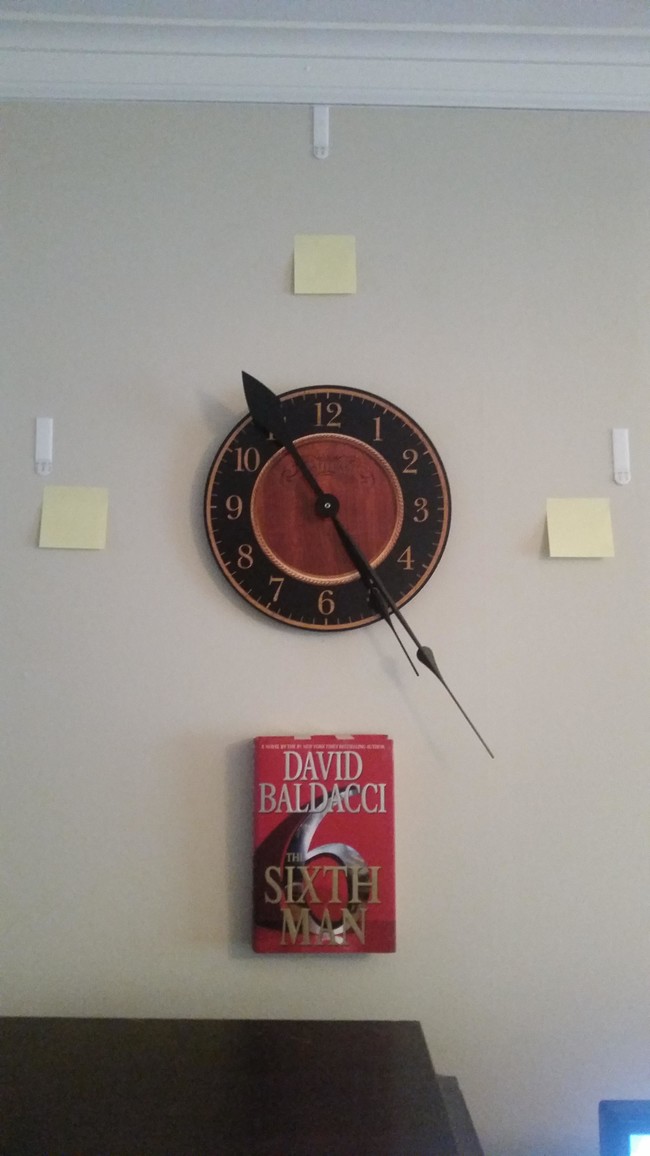
Place the books evenly around the clock face.

Looking good!

You can pick books whose titles contain the numbers …

… or just enjoy your book-themed wall clock and use a calendar or day planner to map out your book reading goals.
You’ll enjoy having a beautiful daily reminder of your reading goals. ?
View original post here
Have something to add to this story? Share it in the comments

Reading is a daily habit for many people. For others, not so much. One of the reasons some people aren’t attracted to reading is that a good read can be hard to find. Sometimes it takes a lot of misses before you get a hit. Before you finally discover a book so marvelously crafted that you read it in one sitting.
A page-turner gives you joy in so many ways. Here are just a few examples:
A truly immersive experience
When was the last time you worked, socialized, or played without being distracted every few minutes by your phone?
A good book blurs out all noise and all distractions in the most magical way. A good book makes you lose track of time. It makes you forget about all your worries, your errands, and to-do lists. The only thing that matters when you read a truly good book is what’s going to happen next – and you can’t stop yourself from turning just one more page.
This type of pleasure is unique; only a good book can provide this type of “losing yourself” experience. Considering how addicted and dependent we are on our digital lives, it might as well be our way out of the rush and hurry of the everyday world.
With a great novel, you’ll see that there’s something more important than Instagram and Facebook. You’ll find purpose and meaning in something that’s not tech-based and battery-dependent. And that’s a personal victory worth celebrating.
Awareness of the simple pleasures
It’s a fast-paced world. Whether you like it or not, you’re most likely participating in it, and probably more than you realize. A book puts this frantic lifestyle on hold for a while. It shows you that being still, being calm, and simply taking in each moment as it unfolds is one of the most priceless pleasures in life.
Curling up with a book – with perhaps a cup of tea in hand – is a luxury you can afford. It costs nothing to focus your mind and heart on a good story, and it’s a welcome break from your usual state of constantly being worried about the next big event, or what to wear to work tomorrow.
Reading a book takes patience, and in our instant-gratification world, it’s the reminder we need to simply pause and be inspired by the beauty of our surroundings. Reading is personal, but it’s universal in its impact. It requires your full attention. Your book is the only thing that matters. No multitasking, no hashtags, no chores can mess with the serenity and bliss a good read offers you. So go on, find your next read.
Have something to add to this story? Share it in the comments

9 times out of 10, emotional reactions are the reason we buy things. Emotion has always been the epicenter of marketing strategies, more so since it became clear that emotional buyers are more impulsive and likely to spend more than rational, reserved ones.
If an ad makes you laugh, sympathize, feel sorry for someone, or feel great about yourself, you instantly develop an emotional association with what’s been advertised. If a young, skinny, beautiful woman flaunts her white teeth at you, that makes you to inevitably compare yourself to her.
The comparison serves one purpose: to make you feel inadequate. Most ads do that. They target the “X enough” inferiority complex, the infinite list that begins “You’re not smart enough, successful enough, pretty enough, fit enough … .”
Ads create feelings of inadequacy and this gives us the momentum to take immediate action to remedy our inadequacies, faults, and shortcomings. We buy a whitening toothpaste, or the latest fashion trends, because we’d feel left out otherwise. We wouldn’t be fashionable, cool, or smartly dressed if we were to follow our own sense of style, would we?
People are capable of experiencing four fundamental emotions: sadness, happiness, fear, and disgust. Of course, different combinations of these emotions create their own matrix of secondary ones – you’ll get apprehension and distraction, contempt and annoyance, anticipation and optimism, to name a few. But let’s go back and examine two basic emotions, happy and sad.
Happiness Drives Up Sales
Marketing exploits these emotions, by triggering them with the right words and visual stimuli.
If an ad, a sales page, or a video makes us happy then we’re more likely to think of that brand or product in positive terms. We’re more likely to share it with others or bring it up in conversation. We’re happy about a product and by sharing it with others we essentially multiply our happiness. Happy is good.
A case in point is that good (happy) news tend to go viral faster than bad news. The Happiness Factor is the determining parameter that makes this possible. Therefore, if you want more online engagement with your communities on Facebook, Twitter, and elsewhere, you should focus on happy news, thoughts, and ideas. Or … should you do the opposite?
Sadness Boosts Empathy
Sadness and sorrow are two other emotions marketing can leverage to drive up sales. Surprisingly enough, sadness activates almost the exact same brain regions as happiness does. Weird? Maybe. Gold mine? Definitely.
When people empathize with the plight of someone (real or fictional) they have a tendency to trust them and invest confidence in them relatively easily.
This is possible because of oxytocin, a chemical our brains release when we read a sorrowful story. Oxytocin is a chemical that helps increase your understanding of and sympathy for others.
Sad stories build connections; they build bridges between the viewer and the narrative being told, which creates the emotional links that tie the reader to the subject or the product.
Put simply, emotions sell. If a marketing campaign revolves around emotions, then it will have a greater impact on its audience.
By creating online marketing campaigns that revolve around emotions, an online marketer:
* Encourages readers to share the article with friends, discuss it online, and chat about it in person, and this conversation boosts word-of-mouth promotion about the product or the business.
* Encourages the viewer to take action that leads in the direction the marketer desires, such as exploring more areas of the website or other products.
* Builds a relationship with the brand at hand where the outcome is that the viewer eventually yields and buys the product or service.
Emotions precede thinking. People tend to experience things through their hearts before rationalizing them with their minds, and this is a fact online marketers can use to make their campaigns more effective and sales-oriented.
Have something to add to this story? Share it in the comments